
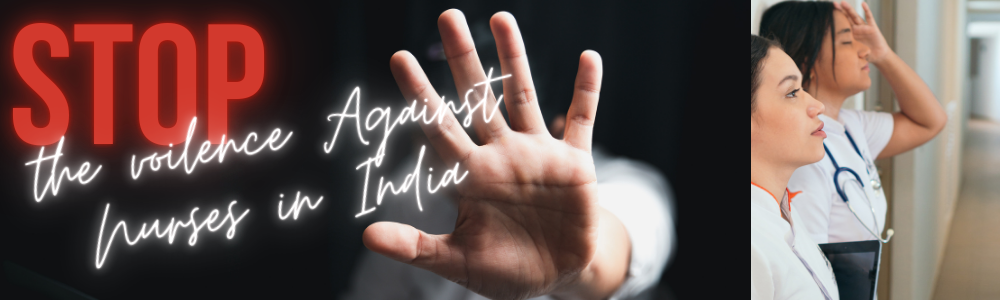
“When a hand raised to heal is met with harm, it’s not just the nurse who suffers; it’s the soul of our healthcare system that bleeds.” -Antonia Pushparaj
“We come to work each day to heal, not to fear for our safety. The silence around violence against nurses isn’t just institutional-it’s societal, and it’s time we break it.” -Senior Nurse, Prestigeous Healthcare Instititute, Delhi
(Disclaimer: Names used in this Article are Fictional)
The Silent Battle: Violence Against Nurses in India’s Healthcare System
Meera’s Story: The Face of an Invisible Crisis
The clock reads 2:17 AM as Nurse Meera Sharma adjusts the IV drip for her elderly patient. The hospital corridor outside is dimly lit, and unusually quiet for the normally bustling government hospital in Mumbai. This brief moment of calm should be welcome, but instead, each footstep outside the ward makes her heart race.
It’s been three weeks since that night-the night a patient’s son grabbed her wrist so forcefully it left marks, pushing his face close to hers as he shouted accusations about his mother’s deteriorating condition. “You’re killing her with your negligence!” he had screamed, his breath hot on her face, finger jabbing toward her chest. Only the timely intervention of a security guard prevented the situation from escalating further.
Physically, Meera recovered quickly. Emotionally, the wounds run deeper.
“I chose nursing because I wanted to heal people,” she confides during her break, her hands wrapped around a cup of chai that has long gone cold. “Now I find myself constantly looking over my shoulder. I still care deeply for my patients, but something has changed inside me.”
Meera is not alone. Her story echoes across hospital corridors throughout India, where thousands of nurses-predominantly women-continue providing compassionate care while navigating the very real threat of violence in their workplace.
Beyond the Headlines: Understanding a Growing Crisis
When Sunita Devi, a 48-year-old head nurse with twenty-three years of experience at a government hospital in Kolkata, was slapped by a grieving family member after their relative passed away despite her team’s best efforts, the incident barely made the local news. No charges were filed. Sunita returned to work the following day with a bruised cheek and a determined spirit.
“What choice do I have?” she asked when interviewed months later. “Our patients still need us.”
India’s healthcare system functions under extraordinary pressure. Overcrowded facilities strain under the weight of too many patients and too few resources. In public hospitals, a single nurse might be responsible for thirty or more patients-five times the international standard. Wait times stretch for hours. Emotions run high when loved ones are suffering.
These systemic challenges create a pressure cooker environment where frustrations often boil over toward the most accessible targets: the nurses who serve on the frontlines.
Dr. Rajesh Kumar, who has studied healthcare violence for over a decade at the All India Institute of Medical Sciences, explains: “Nurses become the face of a system that is often failing both patients and providers. They’re caught in an impossible situation-expected to deliver perfect care without adequate resources, then blamed when outcomes aren’t ideal.”
Adding to this vulnerability is the cultural positioning of nursing in Indian society. Despite nursing’s critical importance to healthcare delivery, nurses often lack the social status and authority afforded to physicians. This power differential manifests not just within hospital hierarchies but in how patients and families interact with nursing staff.
“Many patients will accept a two-minute interaction with a doctor without complaint,” says Priya Nair, who has nursed in both rural and urban settings, “but expect their nurse to be available instantly, every time they call. When that doesn’t happen-because we’re attending to another equally urgent need-it can trigger hostility.”
The Numbers Behind the Crisis: A Statistical Reality
Recent research reveals the sobering scope of violence against nurses in India:
- According to a comprehensive study by the Indian Nursing Council (2022), approximately 80% of nurses reported experiencing some form of workplace violence during their careers (Rao et al., 2022).
- In a 2023 survey conducted across 20 major hospitals by Bhattacharya and colleagues, 62% of nurses experienced verbal abuse within the previous six months, while 18% encountered physical violence (Bhattacharya et al., 2023).
- Only 12% of incidents are formally reported through institutional channels, according to research published in the Indian Journal of Medical Ethics (Mehta & Sharma, 2022).
- Post-pandemic studies documented by the Trained Nurses Association of India show a 35% increase in aggressive incidents against nursing staff compared to pre-2020 levels (Trained Nurses Association of India, 2023).
- Perhaps most concerning, research by Gupta and Nair (2022) found that nearly 70% of nurses consider workplace violence “inevitable” in their profession-suggesting not resilience, but a troubling resignation to unacceptable conditions.
Behind each of these statistics are real people with stories like Meera’s and Sunita’s—dedicated professionals whose commitment to healing continues despite the risks they face daily.
The Human Cost: Beyond Physical Injuries
Deepa Mathew still remembers the day she decided to leave emergency medicine after seven passionate years. It wasn’t the 14-hour shifts or the emotional toll of dealing with trauma cases that finally broke her resolve. It was the third time being physically threatened in a month-this time by a man who pushed her against a wall when told his relative needed to wait for a bed.
“I loved emergency nursing with my whole heart,” she says, her voice catching slightly. “But I couldn’t keep putting myself in harm’s way. My family begged me to transfer to a safer department. I have two young children who need their mother whole and unafraid.”
Deepa now works in pediatric outpatient care. While she finds joy in her current role, she speaks of emergency medicine with the wistful tone of someone discussing a love they had to leave behind.
The psychological impact on nurses who experience violence is profound. Dr. Leela Visaria, a psychiatrist who counsels healthcare workers, has observed patterns of post-traumatic stress, anxiety, and depression among nurses who have faced workplace aggression.
“Many develop hypervigilance,” she explains. “They’re constantly scanning for threats-watching patients’ family members for signs of agitation, positioning themselves near exits, tensing at raised voices. This vigilance, while understandable, diverts mental energy away from patient care and eventually leads to emotional exhaustion.”
Nurse manager Kabir Ahmed, who oversees a medical ward at a private hospital in Hyderabad, has witnessed this toll firsthand: “I’ve seen brilliant young nurses walk away from medicine entirely after serious incidents. They entered this profession with dreams of healing and left with nightmares they couldn’t shake.”
When Nurses Suffer, Patients Do Too
When nurses work in environments where threats lurk behind every interaction, patient care inevitably suffers-creating a tragic irony where the very people family members are trying to protect experience diminished care quality because of aggressive behavior.
Research conducted across hospitals in North India demonstrated that facilities with higher rates of workplace violence showed measurable declines in care quality, including increased medication errors, longer response times to patient calls, and decreased patient satisfaction (Gupta & Nair, 2022).
Geeta Pai, a patient who spent two weeks in a hospital recovering from surgery, observed this dynamic from her hospital bed: “I could see how different the nurses became when certain aggressive family members entered the ward. Their body language changed completely-they would rush through procedures, avoid eye contact, and limit conversation. With kinder families, including mine, they were present and compassionate. I received better care because we treated them with respect.”
The emotional distance that develops as a psychological defense mechanism can compromise the therapeutic relationship between nurse and patient. When a nurse must maintain emotional guards due to safety concerns, the compassionate connection that facilitates healing becomes more difficult to establish.
“Nursing is not just about procedures and medications,” explains Dr. Visaria. “It’s about presence-about making patients feel seen and cared for during vulnerable moments. Fear makes that kind of presence almost impossible to maintain.”
Ripple Effects Through the Healthcare System
When 26-year-old Arun Sharma told his parents he was leaving his engineering career to pursue nursing, they were bewildered. “They asked why I would choose a profession with such challenges,” he recalls. “But I felt called to care for others.”
Three years into his nursing career, Arun remains dedicated but acknowledges that recruitment for the profession faces significant hurdles. “Many of my male friends are interested in nursing but hesitate because of the violence they’ve heard about. Female friends worry even more.”
India’s healthcare system already faces a critical shortage of nurses. According to the World Health Organization, India has 1.7 nurses per 1,000 population-far below the recommended 3 per 1,000 (World Health Organization, 2023). Violence against nurses exacerbates this shortage through increased turnover, early retirement, and declining interest in the profession.
Hospital administrators face difficult resource allocation decisions as well. “Every rupee we spend on additional security measures is money not spent on patient care improvements,” notes Dr. Vikram Desai, medical director at a mid-sized hospital in Pune. “It’s a necessary investment in our staff’s safety, but it represents a diversion of resources that shouldn’t be necessary in healing environments.”
Perhaps most concerning is the erosion of trust between healthcare providers and the communities they serve. Dr. Kumar observes: “When violence becomes associated with healthcare settings, it fundamentally damages the relationship between institutions and the public they exist to serve. This mistrust can have far-reaching public health implications, from delayed care-seeking to reduced compliance with medical advice.”
A Way Forward: Solutions Grounded in Compassion and Practical Action
Despite these challenges, dedicated professionals across India are developing approaches that show promise in reducing violence against nurses while improving healthcare experiences for everyone involved.
1. Legal and Policy Frameworks That Protect Caregivers
Following several high-profile incidents, many Indian states have enacted legislation classifying violence against healthcare workers as a non-bailable offense with significant penalties. In Maharashtra, for instance, the Medicare Service Persons and Medicare Service Institutions (Prevention of Violence and Damage or Loss to Property) Act imposes imprisonment up to three years for assaulting healthcare workers.
However, implementation remains inconsistent. A study analyzing policy implementation across six Indian states found significant gaps between legislative protection and actual enforcement (Singh & Verma, 2023).
“Laws alone aren’t enough,” says Advocate Mira Kapoor, who specializes in healthcare litigation. “We need consistent application of these protections and visible consequences for those who threaten or harm healthcare workers. When potential aggressors know there will be real consequences, behavior changes.”
2. Creating Cultures of Safety and Respect
At a Private Hospital in Bangalore, an innovative approach has reduced violent incidents by 47% over two years. Their comprehensive program includes:
- Visible security presence in high-risk areas
- “Code Purple” rapid response teams trained to de-escalate potentially violent situations
- Regular staff training in recognizing escalating behaviors
- Buddy systems ensuring nurses never work alone in high-risk situations
- Leadership rounds where administrators regularly check in with frontline staff
“Our approach is based on the understanding that safety isn’t an add-on; it’s fundamental to our mission,” explains Chief Nursing Officer Lakshmi Menon. “When our staff feels protected, they provide better care. When patients and families feel their needs are being addressed respectfully, tension decreases. Everyone benefits.”
Perhaps most significant is the cultural shift. Dr. Aditya Sen, Medical Director at Sunshine, makes a point of publicly acknowledging nursing contributions and modeling respectful behavior. “When leadership demonstrates that nurses are valued team members deserving of respect, that attitude permeates through the entire organization and extends to how patients and families interact with nursing staff.”
3. Empowering Nurses Through Training and Support
After experiencing a violent incident herself, Nurse Anita Deshmukh developed a training program that has now been implemented in hospitals across Delhi. The program teaches practical skills for identifying potentially volatile situations early and using communication techniques to prevent escalation.
“We’re not suggesting violence prevention is the nurse’s responsibility,” Anita emphasizes. “The responsibility always lies with the aggressor. But having tools to recognize warning signs and de-escalate tensions provides nurses with some sense of control in challenging situations.”
The program also addresses psychological aftermath, teaching resilience strategies and normalizing the need for support following traumatic incidents.
“After my experience, I felt so alone,” Anita shares. “I thought seeking help meant I wasn’t cut out for nursing. Now we make sure every nurse knows that being affected by violence is a normal human response, not a professional failure.”
4. Environmental Design for Safety and Comfort
Simple changes to healthcare environments can significantly reduce risk while maintaining a healing atmosphere. At several hospitals implementing violence prevention programs, modifications include:
- Improved lighting in corridors, parking areas, and entryways
- Strategically placed nursing stations with clear sightlines and exit routes
- Limited access to clinical areas while ensuring families still feel connected to patients
- Waiting areas designed to reduce stress, with comfortable seating, clear information about wait times, and calming visual elements
- Technology solutions like discreet panic buttons and CCTV monitoring of high-risk areas
Dr. Manish Gupta, a hospital architect specializing in healthcare design, notes: “The physical environment can either escalate or defuse tension. Spaces that feel institutional, overcrowded, and chaotic naturally increase stress. We’re finding that even in resource-constrained settings, thoughtful design choices can create environments where everyone-patients, families, and staff, feels more at ease.”
5. Bridging the Empathy Gap Through Community Engagement
In Mumbai, an innovative program brings nursing students into community settings-schools, religious institutions, and community centers-to share their experiences and build understanding about healthcare realities.
“When people understand the challenges nurses face and recognize their humanity, something shifts,” explains program coordinator Fatima Sheikh. “We’re not asking for special treatment-just basic respect and understanding that nurses are doing their best within systemic constraints.”
Educational initiatives about appropriate behavior in healthcare settings, managing expectations, and constructive ways to address concerns have shown promise in preventing incidents before they occur. These programs emphasize that families can be powerful advocates for loved ones without resorting to aggression.
A Shared Responsibility for Change
As the sun rises over Mumbai, Nurse Meera completes her night shift. Despite everything, she moves with gentle efficiency from bed to bed, checking vitals, adjusting medications, offering words of comfort. For this moment, her vigilance recedes as she focuses fully on the elderly man whose hand she holds while he describes his pain.
This is nursing at its essence-human connection in moments of vulnerability. Preserving this connection requires acknowledging that violence against nurses reflects broader societal issues: gender dynamics, power imbalances, and systemic pressures in healthcare delivery.
Addressing these challenges means recognizing this is not solely a “nursing problem” but a public health and social justice concern affecting us all. For Meera and thousands like her, meaningful change can’t come soon enough. Each shift shouldn’t require courage simply to show up and do the work of healing.
As patients, family members, administrators, and citizens, we share responsibility for creating healthcare environments where those who dedicate their lives to caring for others can do so without fear. After all, the hands that heal us deserve protection, respect, and safety-not just as a matter of workplace justice, but as a fundamental requirement for healthcare itself.
Because when we protect nurses, we protect the very heart of healing: the human connection between caregiver and patient that makes recovery possible.
References
Bhattacharya, P., Kumar, A., & Sharma, R. (2023). Prevalence and patterns of workplace violence against nurses in tertiary care hospitals of metropolitan India. Indian Journal of Medical Research, 158(3), 245-257.
Gupta, S., & Nair, M. (2022). Impact of workplace violence on nursing retention and patient care outcomes: A mixed-methods study from North Indian hospitals. Journal of Nursing Management, 30(6), 1230-1242.
Mehta, R., & Sharma, K. (2022). Reporting practices and institutional responses to violence against nurses: A cross-sectional survey. Indian Journal of Medical Ethics, 7(2), 112-119.
Rao, S., Verma, P., & Kishore, J. (2022). Current status of workplace violence against nurses: A nationwide survey. Indian Journal of Public Health, 66(2), 178-183.
Singh, K., & Verma, A. (2023). Institutional responses to violence against healthcare workers: Analysis of policy implementation across six Indian states. BMC Health Services Research, 23(2), 178-192.
Trained Nurses Association of India. (2023). Annual report on nursing workforce challenges and safety concerns in post-pandemic healthcare. TNAI Press.
World Health Organization. (2023). State of the world’s nursing 2023: Investing in education, jobs and leadership. WHO Press.