
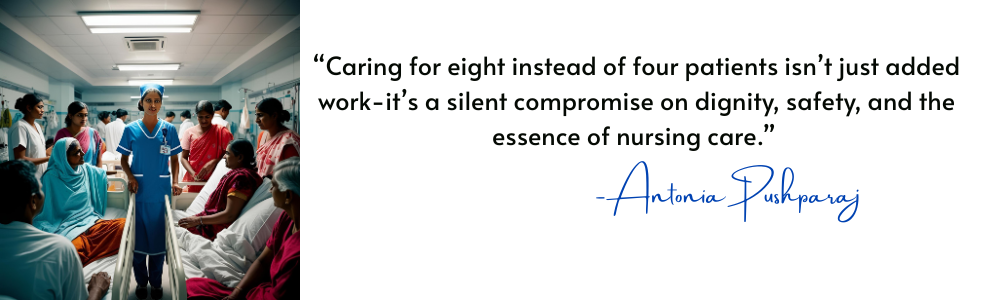
In the bustling corridors of an urban government hospital in New Delhi, Nurse Priya moves swiftly between beds, administering medications to one patient while mentally preparing for the next three who need immediate attention. Her 12-hour shift began at 7 AM, and it’s now 2 PM-she hasn’t had time for lunch, a proper bathroom break, or even a moment to collect her thoughts. This isn’t an unusual day; this is her reality, shared by thousands of nurses across India’s healthcare system.
The Indian Context: A System Under Strain
India’s healthcare system has long been characterized by remarkable resilience despite limited resources. Nurses form the backbone/heartbeat/face (!!!) of this system, often working under conditions that would be considered unacceptable in many other countries. While the World Health Organization recommends a nurse-to-patient ratio of 1:4 for general wards and 1:1 for intensive care units, the reality in Indian hospitals paints a starkly different picture.
In many government hospitals across India, a single nurse might be responsible for 20-30 patients during day shifts and even more at night. In rural settings, these numbers can climb higher, with one nurse sometimes caring for an entire ward of 40-50 patients. This extreme disparity doesn’t just create exhaustion among healthcare workers-it fundamentally compromises patient safety and care quality.
The Numbers Tell a Grim Story
The statistics regarding India’s nursing workforce reveal the depth of the crisis:
- India has a nurse-to-population ratio of 1.96 per 1,000 people, far below the WHO recommendation of 3 nurses per 1,000 population
- There is a shortage of approximately 2 million nurses in the Indian healthcare system
- Nearly 20% of trained nurses migrate overseas for better working conditions and compensation
- A 2023 survey found that 78% of nurses in India report symptoms of burnout
- Patient mortality increases by approximately 7% for each additional patient added to a nurse’s workload beyond recommended ratios
These numbers aren’t just abstract statistics-they represent real human costs, both for patients who receive compromised care and for the nurses who struggle under impossible workloads.
The Consequences: Beyond Exhaustion
The implications of extreme nurse-patient ratios extend far beyond tired healthcare workers:
For Patients
When nurses are overwhelmed, the consequences for patients can be severe. Medication errors increase, infections go unnoticed until they become serious, and subtle signs of deterioration might be missed. Studies consistently show that higher nurse workloads correlate with increased patient mortality, longer hospital stays, and higher readmission rates.
In India’s context, this is particularly concerning given the country’s high burden of infectious diseases alongside growing rates of chronic conditions requiring complex care. The patients who suffer most are often those already marginalized-the elderly, the rural poor, and those without family advocates at their bedside.
For Nurses
The toll on nurses themselves is equally alarming. Chronic stress, compassion fatigue, and moral distress are common. Many Indian nurses report feeling they cannot provide the standard of care they were trained to deliver, creating profound professional and personal anguish.
A senior nurse at a hospital in Bangalore expressed it poignantly: “We enter this profession to care for people. When we can’t give adequate care because there are simply too many patients, something inside us breaks. We carry that weight home every day.”
Physical health consequences are also significant, with nurses reporting higher rates of musculoskeletal disorders, chronic pain, and compromised immune function. The mental health impact is equally severe, with depression and anxiety rates among Indian nurses estimated to be twice that of the general population.
For the Healthcare System
The unsustainable workloads create a vicious cycle. Burnout leads to high turnover rates, which exacerbates staffing shortages. Training new nurses takes time, and the loss of experienced nurses means a loss of invaluable institutional knowledge and mentorship capacity.
This cycle threatens the stability of India’s entire healthcare system, particularly as the country continues to expand healthcare access through initiatives like Ayushman Bharat.
Charting a Path Forward
Addressing India’s nurse-patient ratio crisis requires multi-faceted approaches:
1. Policy-Level Interventions
Legislation establishing mandatory minimum nurse-to-patient ratios would create accountability and drive systemic change. States like California in the US have successfully implemented such legislation, resulting in measurable improvements in both patient outcomes and nurse retention.
India could adapt similar models, perhaps phasing in requirements to allow hospitals time to adjust. The financial investment would be substantial, but the return-in terms of lives saved and improved healthcare outcomes-would be greater.
2. Education and Retention Strategies
Expanding nursing education capacity while improving quality is essential. This means investing in nursing colleges, updating curricula to reflect contemporary healthcare challenges, and creating clear career advancement pathways for nurses.
Retention strategies must address both compensation and working conditions. While higher salaries are important, nurses consistently cite workplace safety, reasonable workloads, and professional respect as equally crucial factors in their decision to remain in the profession.
3. Technology as an Enabler
Strategic implementation of technology can help extend the reach of nursing care. Electronic health records that reduce documentation burden, remote monitoring systems that alert nurses to changes in patient status, and even AI-assisted triage can help nurses work more efficiently.
However, technology should supplement, not replace, adequate staffing. The human element of nursing care-the reassuring presence, the skilled observation, the compassionate touch-cannot be automated.
4. Elevating Nursing’s Professional Status
In Indian society, nursing has historically held lower status than medicine, despite its critical importance. Changing this perception requires concerted effort-from media campaigns highlighting nursing excellence to policy changes that give nurses greater autonomy and voice in healthcare leadership.
When nurses are respected as essential healthcare professionals rather than viewed as physician assistants, both recruitment and retention improve.
5. Community Involvement and Education
Educating patients and families about realistic expectations and how they can support care delivery can help reduce some pressures on nurses. Family caregivers, properly instructed, can assist with basic care needs, allowing nurses to focus on clinical priorities.
Community health workers can also bridge gaps, particularly in rural areas, by providing preventive care and education that reduces hospitalization needs.
A Call to Collective Action
The nurse-patient ratio crisis in India cannot be solved by nurses alone. It requires commitment from hospital administrators, policymakers, medical professionals, and the public. Each of us-whether we’re healthcare workers, patients, family members, or citizens-has a stake in addressing this issue.
As we contemplate the future of healthcare in India, we must ask ourselves what kind of system we want. One where nurses are forced to provide minimal care to many, or one where they can deliver optimal care to a reasonable number of patients? The answer seems clear, but achieving it will require both moral courage and practical investment.
For Nurse Priya and her colleagues across India, the hope is that their daily reality will soon align more closely with their professional calling-to provide compassionate, comprehensive care to those who need it most. Their dedication deserves nothing less than our full support in creating systemic change.
References
Das, S., & Sharma, P. (2023). Impact of nurse staffing ratios on patient outcomes in tertiary care hospitals of India. Indian Journal of Medical Research, 157(2), 112-124.
Kumar, R., Patel, V., & Nair, M. (2022). Nursing workforce challenges in India: A systematic review and meta-analysis. BMC Health Services Research, 22(1), 345-359.
Mehta, A., & Gupta, S. (2023). Burnout among healthcare workers in India during post-pandemic recovery: Prevalence and contributing factors. Journal of Nursing Management, 31(4), 789-801.
Singh, J., & Verma, R. (2024). Economic analysis of nurse-patient ratios and healthcare outcomes: Evidence from Indian public hospitals. Health Economics Review, 14(1), 15-28.
World Health Organization. (2023). State of the world’s nursing: India country profile report. WHO Press.